
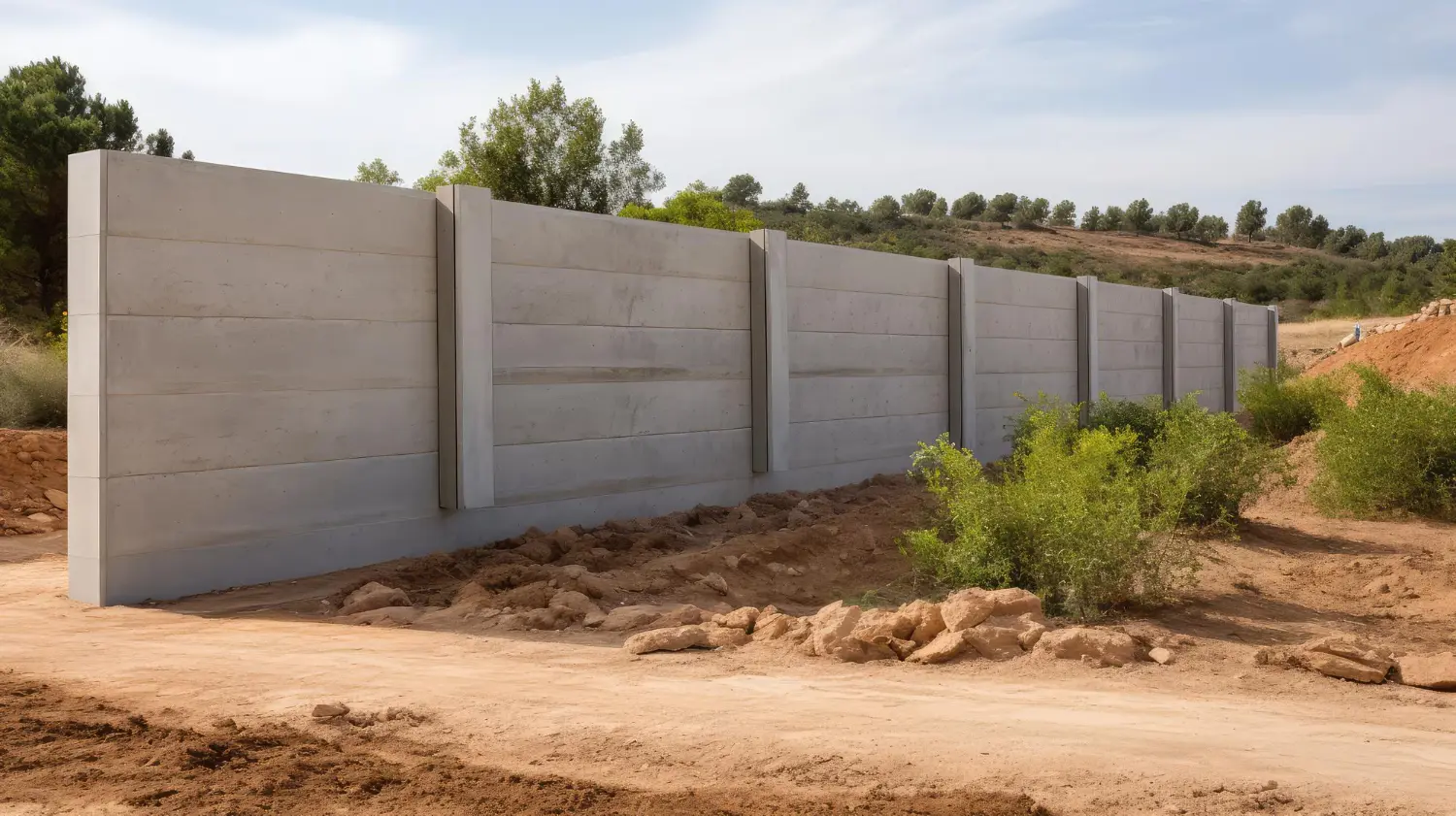
Best Precast Retaining Wall Manufacturer in Gujarat: A Guide for Industrial & Infrastructure Projects
Looking for a precast retaining wall manufacturer in Gujarat? Learn what to consider for industrial, infrastructure, solar and commercial projects and how to choose the right supplier.
Retaining walls are easy to overlook when you look at a completed infrastructure project.
But before a highway, industrial facility, solar park, warehouse or large development can operate safely, the land itself often needs to be managed.
Different elevations need to be supported.
Slopes need to be controlled.
Soil needs to be retained.
Roads and structures need stable ground conditions.
This is where retaining walls become an important part of civil infrastructure.
For large projects across Gujarat, precast retaining walls can provide a practical solution where controlled manufacturing, repeatable components and efficient installation are important.
However, choosing a retaining wall manufacturer should involve much more than comparing prices.
The manufacturer's production capability, product quality, engineering requirements, site conditions, transportation and installation all need to be considered.
What Is a Retaining Wall?
A retaining wall is a structural system designed to hold back soil or other materials where there is a difference in ground elevation.
Without adequate support, soil can move downhill due to gravity, potentially affecting roads, buildings, drainage systems and other infrastructure.
Retaining walls help create usable and stable areas where natural or constructed terrain has different levels.
They are commonly found around:
- Highways
- Industrial sites
- Railway infrastructure
- Solar parks
- Warehouses
- Commercial developments
- Residential developments
- Bridges
- Roads and embankments
The appropriate retaining wall design depends on the project's engineering requirements, soil conditions, loads, drainage and site geometry.
Why Are Retaining Walls Important in Gujarat?
Gujarat is experiencing significant development across industrial, renewable energy, transportation and urban infrastructure.
Large developments frequently involve extensive site preparation.
A project may need to create roads across uneven terrain, establish platforms for buildings or equipment, manage embankments or separate areas at different elevations.
This makes ground management an important part of project planning.
In renewable energy developments, for example, large sites may require internal roads and supporting infrastructure across varying terrain.
Sachi Precast has supported major renewable energy developments including the Adani Green Renewable Park and NTPC Solar Park.
Where Are Precast Retaining Walls Used?
Industrial Projects
Industrial facilities often require large, level areas for factories, warehouses, equipment and internal roads.
When a site contains elevation differences, retaining structures can help create stable development platforms.
This is particularly relevant for large industrial plots where site utilisation and infrastructure planning need to work together.
Our previous guide on Industrial Precast Manufacturing in Ahmedabad explores why large industrial developments require dependable precast manufacturing partners.
Highway and Road Projects
Roads frequently cross changing terrain.
Cut-and-fill construction can create differences in elevation along the road corridor.
Retaining walls can help support soil alongside roads and embankments where appropriate.
They may also be used around ramps, approaches and other infrastructure where space is limited.
Renewable Energy Projects
Large solar and renewable energy developments can cover substantial areas.
Internal roads, equipment platforms and drainage systems may need to accommodate changes in ground level.
Retaining structures can therefore form part of the supporting civil infrastructure.
This connects closely with Why Renewable Energy Projects Are Choosing Precast Construction.
Commercial and Residential Developments
Retaining walls can also be useful where developments are constructed on sloping or stepped sites.
They can help create usable areas while managing differences in elevation.
Why Consider Precast Retaining Walls?
Precast construction moves much of the manufacturing process away from the final construction site.
Components can be produced in a controlled manufacturing environment and transported when required.
For large projects, this can provide several practical advantages.
Controlled Manufacturing
Factory production allows manufacturers to maintain controlled processes throughout manufacturing.
This can support consistency across multiple components.
Repeatable Components
Large projects may require numerous retaining wall components with similar specifications.
Manufacturing repeatable units can simplify planning and installation.
Faster Site Installation
Because the components are manufactured before reaching the site, installation can proceed without waiting for the entire structure to be constructed from scratch on location.
The actual installation time depends on site conditions, engineering requirements, equipment and project planning.
Reduced On-Site Manufacturing
Precast construction can reduce the amount of concrete manufacturing required directly at the project site.
This can be particularly useful where construction areas are congested or project schedules are tightly coordinated.
Precast Retaining Walls Are Not a One-Size-Fits-All Solution
A retaining wall is a structural system.
It cannot simply be selected based on appearance or price.
The appropriate solution depends on factors such as:
- Retained soil height
- Soil characteristics
- Groundwater
- Drainage
- Surcharge loads
- Foundation conditions
- Site geometry
- Adjacent structures
- Seismic considerations
- Project-specific engineering requirements
For this reason, retaining wall design should be determined by qualified project engineers based on the actual site.
The manufacturer then needs to produce components according to the approved requirements.
What Should You Look for in a Precast Retaining Wall Manufacturer?
Manufacturing Capacity
A large industrial or infrastructure project may require significant quantities of precast components.
The manufacturer should have the production capability and planning systems necessary to meet the required schedule.
Capacity is not simply about how much concrete can be produced.
It is about maintaining quality while managing production volumes and delivery commitments.
Consistent Product Quality
Retaining wall components need to be manufactured consistently.
Variations in dimensions can create installation challenges and affect project coordination.
Controlled production and quality inspection therefore matter.
Engineering Coordination
The manufacturer should be able to understand the drawings, specifications and technical requirements provided by the project team.
Clear communication between engineers, contractors and manufacturers helps minimise errors before production begins.
Transportation Capability
Retaining wall components can be large and heavy.
Transportation must account for:
- Component dimensions
- Vehicle capacity
- Loading
- Unloading
- Site access
- Delivery sequencing
For projects located across Gujarat, logistics planning can have a significant effect on the overall project schedule.
Installation Support
Manufacturing is only one stage.
The components ultimately need to be installed correctly at the project site.
The responsibilities for transportation, unloading and installation should therefore be clearly established before the order is finalised.
What Makes a High-Quality Retaining Wall?
Quality is not determined by one characteristic.
It comes from the complete manufacturing process.
Concrete Quality
The concrete needs to meet the requirements specified for the project.
Reinforcement
Reinforcement must be designed and placed according to the approved engineering specifications.
Accurate Dimensions
Consistent dimensions help components fit the intended installation configuration.
Proper Curing
Concrete requires appropriate curing to develop its intended properties.
As explained in Why Concrete Doesn't Become Strong Overnight and Why Curing Matters, curing is an important part of concrete performance.
Quality Inspection
Products should be inspected before dispatch to identify issues before they reach the construction site.
Drainage Is Critical Behind Retaining Walls
A retaining wall does not work independently from the surrounding site.
Water management is particularly important.
Water accumulating behind a retaining structure can create additional pressure and needs to be considered in the overall design.
This is why retaining wall projects often need to be coordinated with drainage infrastructure.
Depending on the project, supporting products may include Slope Drains, U Drains with Cover, Hume Pipes, Manhole Chambers and Junction Chambers.
The objective is not simply to retain soil.
It is to create a complete infrastructure system where structural and drainage requirements work together.
Retaining Walls and the Larger Infrastructure Network
Consider an industrial development built on a site with varying elevations.
The project may require retaining walls to create stable platforms.
Roads then need to connect those platforms.
Stormwater needs to be collected.
Drainage needs to pass beneath access roads.
Inspection points need to be provided.
In such a project, the retaining wall is one part of a much larger system.
That system may also include Box Culverts, U Drains, Hume Pipes and other precast infrastructure.
This is why choosing a manufacturer with a broad product portfolio can simplify procurement and coordination.
Why Project Experience Matters
Large infrastructure projects require manufacturers to work within established engineering and construction programmes.
Sachi Precast has supplied precast solutions for projects associated with transportation, renewable energy and industrial infrastructure.
These include the Mumbai–Ahmedabad Bullet Train Project, Adani Green Renewable Park, NTPC Solar Park and Tata Power Mundra.
Each project has different requirements.
The common requirement is dependable manufacturing and execution within complex construction environments.
Precast Retaining Walls vs Conventional Construction
There is no universally superior construction method.
The right approach depends on project conditions.
Conventional retaining structures may be appropriate where the design requires extensive site-built construction.
Precast can be particularly attractive where projects require:
- Repeatable components
- Controlled manufacturing
- Large quantities
- Planned installation
- Reduced on-site concrete work
- Predictable construction schedules
The decision should ultimately be based on engineering suitability, site conditions, project schedule and lifecycle requirements.
Why Long-Term Performance Matters
A retaining wall is not a temporary construction element.
It can remain part of a site's infrastructure for decades.
That makes long-term performance an important consideration during procurement.
The cheapest quotation may not always provide the best overall value if differences in quality, specifications, installation or maintenance create additional costs later.
This is why Sachi Precast focuses on long-term performance instead of short-term solutions.
Why Choose Sachi Precast for Retaining Wall Requirements?
Sachi Precast manufactures engineered precast concrete products for infrastructure, industrial, renewable energy, transportation and commercial projects across Gujarat and India.
Our Retaining Wall solutions form part of a broader portfolio that includes drainage, structural and infrastructure products.
From Hume Pipes and Box Culverts to Manhole Chambers, U Drains, Slope Drains, Precast Tanks, Solid Slabs and Column Footing and Wall Panels, our manufacturing portfolio is designed to support diverse project requirements.
Our experience with major developments also gives project teams access to a manufacturer familiar with the demands of large-scale infrastructure supply.
What Should You Ask Before Ordering a Precast Retaining Wall?
Before requesting a quotation, project teams should establish:
What Is the Required Retaining Height?
The height of retained soil directly affects structural requirements.
What Are the Site Conditions?
Soil, groundwater, terrain and existing infrastructure should be assessed.
What Loads Will the Wall Experience?
Traffic, buildings, equipment and other loads near the wall can influence the design.
How Will Water Be Managed?
Drainage behind and around the wall should be considered as part of the overall design.
What Quantity Is Required?
Total quantities help the manufacturer plan production and delivery.
What Is the Project Timeline?
Manufacturing and transportation schedules should align with site installation.
Who Is Responsible for Installation?
Clearly defining installation responsibilities helps avoid confusion during execution.
Frequently Asked Questions
What is a precast retaining wall?
A precast retaining wall is a factory-manufactured concrete retaining system designed to hold back soil where there is a difference in ground elevation. Its design and specifications depend on project-specific engineering requirements.
Where are precast retaining walls used?
They can be used in industrial developments, highways, roads, renewable energy projects, commercial developments, railway infrastructure and sites with changes in ground elevation.
Are precast retaining walls suitable for industrial projects?
Yes, they can be suitable for industrial projects where engineered retaining structures are required. The appropriate system depends on site conditions, loads, soil characteristics and project design.
Are precast retaining walls faster to install than conventional walls?
Precast components can support faster and more predictable installation because they are manufactured before arriving at the site. Actual installation time depends on site conditions, equipment and project requirements.
What affects the cost of a precast retaining wall?
Cost can depend on wall height, length, design, reinforcement, foundation requirements, site conditions, transportation, installation and project specifications.
Does a retaining wall require drainage?
Drainage is an important consideration in retaining wall design because water accumulation can affect pressures behind the wall. The drainage arrangement should be determined according to the project's engineering design.
How do I choose a retaining wall manufacturer in Gujarat?
Consider manufacturing capacity, quality control, engineering coordination, project experience, product specifications, transportation capability and the manufacturer's ability to meet your required quantity and schedule.
Does Sachi Precast supply retaining walls across Gujarat?
Sachi Precast manufactures precast retaining walls and other infrastructure products for projects across Gujarat and India, subject to project requirements and logistics.
Conclusion
A retaining wall is much more than a concrete structure placed against soil.
It is part of a larger infrastructure system that needs to account for ground conditions, loads, drainage, construction sequencing and long-term performance.
For industrial, renewable energy, transportation and commercial projects across Gujarat, precast retaining walls can offer the advantages of controlled manufacturing, repeatable components and planned installation when the solution is appropriate for the project.
The most important decision, however, is not simply finding the lowest price.
It is finding a manufacturer capable of delivering the required product, quality, quantity and schedule.
Sachi Precast combines a broad precast portfolio with experience supporting major infrastructure and development projects across Gujarat and India.
Explore the complete Sachi Precast product range, view our projects, or contact our team to discuss your retaining wall or infrastructure requirements.
Build Smarter With Sachi Precast
From ready-made precast components to fully customized solutions, we handle everything from manufacturing to on-site erection — delivering faster, stronger, and more efficient construction outcomes.