
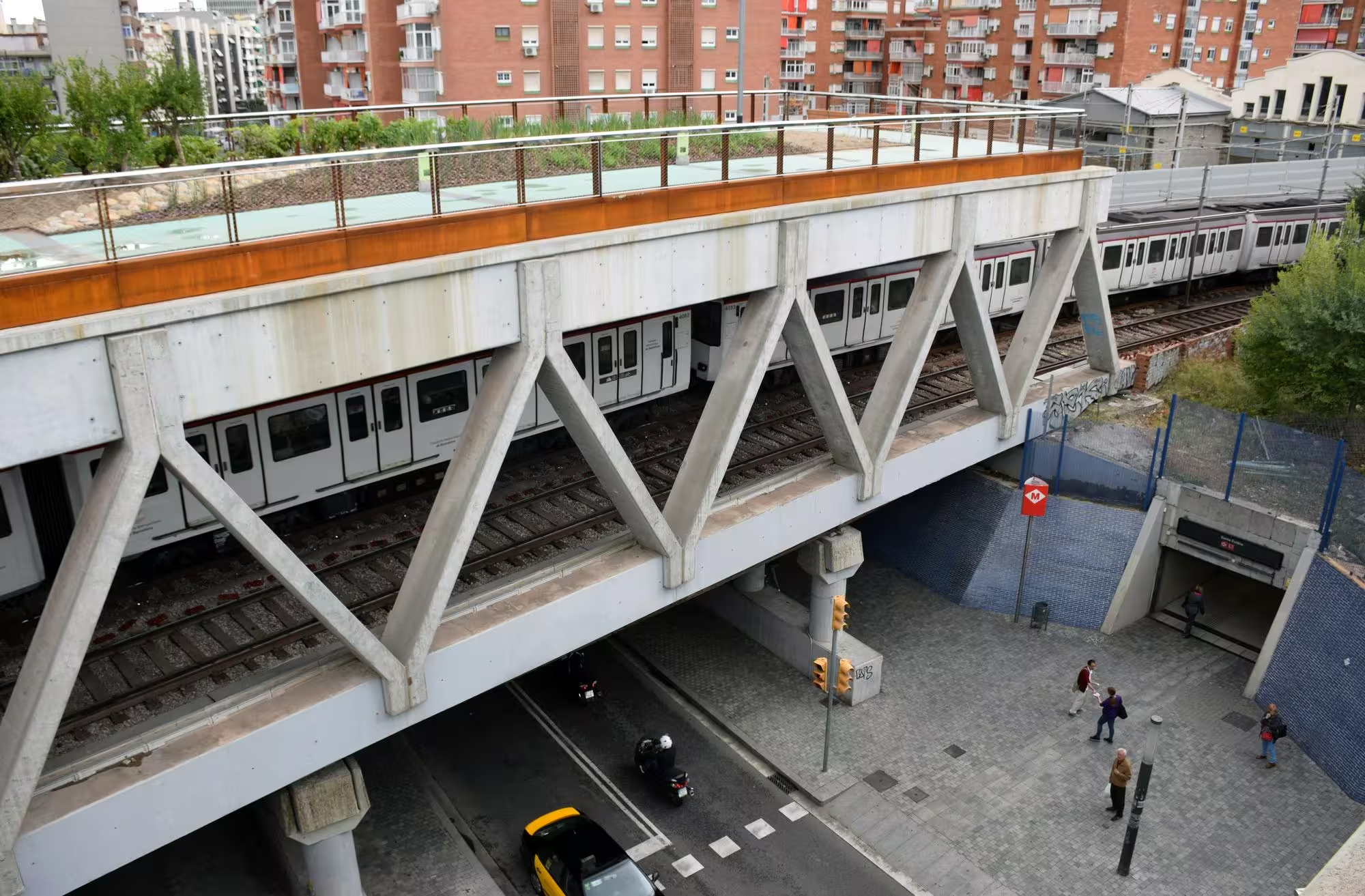
What Nagpur Metro’s 120-Tonne Precast Pier Arms Tell Us About the Future of Infrastructure Construction
How do you construct massive infrastructure projects in growing cities without manufacturing every structural component directly at the project site?
The latest developments at Nagpur Metro offer an interesting answer.
According to a recent report on the Nagpur Metro expansion, massive 120-tonne precast pier arms are being transported and installed for stations along the Reach-3A Hingna corridor.
The report states that each station requires 20 pier arms, with 140 precast components planned across seven stations.
But perhaps the most interesting part of this development is not simply the size of these components.
It is what their use tells us about the changing way India is building large-scale infrastructure.
Why Manufacture Something 52 Kilometres Away From the Construction Site?
At first, transporting a 120-tonne concrete component over approximately 52 kilometres may sound unnecessarily complicated.
Why not simply construct it at the final location?
The answer lies in one of the fundamental ideas behind precast construction.
Instead of carrying out every stage of concrete construction at an active project site, precast components can be manufactured separately under planned production conditions and transported when they are ready for installation.
For major infrastructure projects, this can change how construction is planned.
The Nagpur Metro development is an excellent example of how precast construction can separate manufacturing from final installation.
And that distinction matters.
Construction Sites Are Becoming Assembly Sites
Traditionally, large concrete structures required extensive activity directly at the construction site.
Formwork had to be prepared.
Reinforcement had to be positioned.
Concrete had to be poured.
Curing had to take place.
Only then could the next stage begin.
Precast construction changes this sequence.
Components can be manufactured while other activities continue at the project location.
Once ready, they can be transported and installed according to the project's construction schedule.
This is one reason the question of why predictability is becoming one of the most valuable assets in construction has become increasingly relevant for modern developers and infrastructure planners.
Bigger Projects Require Better Planning
The Nagpur Metro example also demonstrates something important.
Precast construction does not eliminate complexity.
It changes where that complexity is managed.
Manufacturing a 120-tonne component requires planning.
Transporting it requires planning.
Lifting it requires planning.
Installing it requires planning.
But when these activities are carefully coordinated, large infrastructure components can be manufactured away from crowded project locations and brought to the site according to execution requirements.
This approach becomes particularly valuable as infrastructure projects increase in scale.
Factory-Controlled Manufacturing Is Becoming More Important
One of the most significant advantages associated with precast construction is the ability to manufacture concrete components in controlled production environments.
This allows greater attention to:
- Material consistency
- Dimensional accuracy
- Production processes
- Curing
- Inspection
- Quality control
As we recently discussed in Why Concrete Doesn’t Become Strong Overnight (And Why Curing Matters), the performance of concrete depends heavily on what happens during manufacturing and curing.
For infrastructure projects expected to operate for decades, these details matter.
Precast Is Not Just About Building Faster
Speed is often the first advantage associated with precast construction.
But projects such as the Nagpur Metro demonstrate that the bigger conversation is about how construction can become more organised.
The potential benefits include:
- Parallel manufacturing and site preparation
- Reduced dependence on extensive on-site casting
- Greater production consistency
- Better project sequencing
- Improved construction predictability
- Reduced on-site complexity
This is why precast construction continues to find applications across transportation, renewable energy, industrial, commercial, residential, and urban infrastructure projects.
Transportation Infrastructure Has Long Relied on Precast Solutions
Metro projects are not the only major transportation developments using precast technology.
Across India, large infrastructure projects increasingly rely on precast components for applications where manufacturing consistency, installation planning, and project timelines are important.
Sachi Precast's experience supporting the Mumbai–Ahmedabad Bullet Train Project provides another example of how precast solutions contribute to major transportation infrastructure.
Different projects require different products and engineering approaches.
But the underlying principle remains similar:
Manufacture with precision.
Plan logistics carefully.
Install efficiently.
Build for long-term performance.
The Same Principles Apply Beyond Metro Projects
The components used for a metro station may look very different from those required for a solar park, industrial facility, residential development, or drainage network.
But many of the advantages of precast construction remain relevant across sectors.
Products such as RCC Pipes, Box Culverts, Precast Boundary Walls, and U-Shaped Channel Sections can all support larger infrastructure systems when manufactured and planned according to project requirements.
This versatility is one reason precast construction is no longer limited to infrastructure projects.
What Can Developers Learn From the Nagpur Metro Project?
Perhaps the biggest lesson is that the future of construction is not simply about building bigger.
It is about building more intelligently.
Large-scale projects require:
- Better planning
- Greater coordination
- Reliable manufacturing
- Efficient logistics
- Consistent quality
- Predictable execution
Precast construction provides one approach to managing these requirements.
The Nagpur Metro's use of massive precast components demonstrates how manufacturing, transportation, and installation can become carefully planned parts of a larger construction system.
India Is Building at a Scale That Demands New Approaches
India's infrastructure requirements are growing rapidly.
New transportation networks are being developed.
Renewable energy capacity is expanding.
Cities are growing.
Industrial corridors are evolving.
Commercial and residential developments are becoming larger.
As the scale of construction increases, the methods used to deliver these projects must evolve as well.
The question is no longer simply:
"Can we build this?"
Increasingly, it is:
"How can we build this with greater consistency, predictability, and long-term performance?"
This is where modern precast construction is becoming increasingly relevant.
How Sachi Precast Supports Modern Infrastructure
At Sachi Precast, we support infrastructure, transportation, renewable energy, industrial, commercial, and residential developments through engineered precast solutions designed for reliable long-term performance.
Our experience includes projects such as the Adani Green Renewable Park, NTPC Solar Park, Tata Power Mundra, and the Mumbai–Ahmedabad Bullet Train Project.
From RCC Pipes and Box Culverts to Precast Boundary Walls and U-Shaped Channel Sections, our focus remains on supporting projects through manufacturing consistency, engineering expertise, and dependable execution.
For a broader understanding of the technology, applications, and future of the industry, explore our complete guide to Precast Construction in Gujarat.
Frequently Asked Questions
What precast components are being used in the Nagpur Metro expansion?
According to recent news reports, 120-tonne precast pier arms are being transported and installed for stations along the Reach-3A Hingna corridor of the Nagpur Metro expansion.
Why are large infrastructure projects using precast construction?
Precast construction allows components to be manufactured separately from the final project site, supporting controlled production, parallel site activities, planned logistics, and efficient installation.
Does precast construction eliminate on-site work?
No. Precast construction reduces certain on-site manufacturing activities, but transportation, lifting, installation, connections, and other project requirements still require careful planning and execution.
Is precast construction only suitable for metro and transportation projects?
No. Precast solutions are used across transportation, renewable energy, industrial, commercial, residential, and public infrastructure developments.
How does Sachi Precast support infrastructure projects?
Sachi Precast manufactures engineered precast solutions for infrastructure, transportation, renewable energy, industrial, commercial, and residential developments, backed by experience across major projects in Gujarat and India.
Build Smarter With Sachi Precast
From ready-made precast components to fully customized solutions, we handle everything from manufacturing to on-site erection — delivering faster, stronger, and more efficient construction outcomes.