
Precast Concrete Products for Infrastructure Projects in India: Applications, Specifications and Sourcing
India's infrastructure development depends on more than roads, buildings and bridges. Beneath and around these structures are the concrete components that support drainage, foundations, utility networks, earth retention and site development.
For infrastructure developers, EPC contractors, civil contractors, industrial companies and government project teams, sourcing the right precast concrete products is an important procurement decision. The products must meet the project's engineering specifications, withstand the intended operating conditions and arrive according to the construction schedule.
This is where precast concrete manufacturing plays an important role. Components are produced before being transported to the installation site, allowing suitable construction activities to take place in a manufacturing environment rather than entirely on-site.
However, not every precast product serves the same purpose. A box culvert designed for a road crossing cannot automatically replace a drainage channel. A retaining wall requires different engineering considerations from a foundation or an underground chamber.
Selecting the right product requires an understanding of its application, dimensions, loading requirements, installation conditions and long-term maintenance needs.
Sachi Precast manufactures precast concrete solutions for infrastructure, renewable energy, industrial and other construction applications. Its product portfolio includes RCC pipes, box culverts, U drains, manhole chambers, foundations, retaining walls and other precast components.
This guide explains the major precast concrete product categories used in infrastructure projects across India, the technical factors buyers should evaluate and how to approach supplier selection for commercial and industrial requirements.
Why precast concrete products are important for Indian infrastructure
Infrastructure projects often require repeated components across extensive sites or multiple construction locations. Examples include drainage sections along roads, culverts beneath access routes, inspection chambers within utility networks and foundation elements for infrastructure installations.
Manufacturing suitable components before they reach the site can support more structured production and installation planning.
Consistency across repeated components
When a project requires many similar components, factory-based manufacturing can help establish repeatable production processes and dimensional checks.
This is particularly relevant for drainage systems, chambers, culverts and other products that need to fit together according to approved drawings.
Consistency still depends on the manufacturing process, appropriate quality control and compliance with the applicable specifications.
Reduced dependence on on-site casting
Precast components can reduce the need to undertake certain concrete casting activities at the final installation location.
This can be useful at sites where space, labour availability, access or construction sequencing makes extensive on-site casting difficult.
The overall benefit depends on whether the product can be manufactured, transported and installed efficiently under the project's conditions.
Coordination with large construction programmes
Roads, renewable energy parks, industrial facilities and other infrastructure developments frequently involve several work packages progressing at the same time.
Precast products can be manufactured according to planned delivery requirements, provided that the designs, quantities and approvals are sufficiently established.
This helps connect procurement and manufacturing with site readiness.
Suitability for different infrastructure applications
Precast concrete is not restricted to one type of construction. Different components can support drainage, foundations, access structures, retaining systems, utility networks and structural applications.
The appropriate product depends on its intended function and the project's technical requirements.
Major precast concrete products used in infrastructure projects
Infrastructure procurement often involves several product categories within a single project. Understanding their individual functions helps contractors and developers identify the right requirements before requesting quotations.
1. RCC pipes for drainage and water conveyance
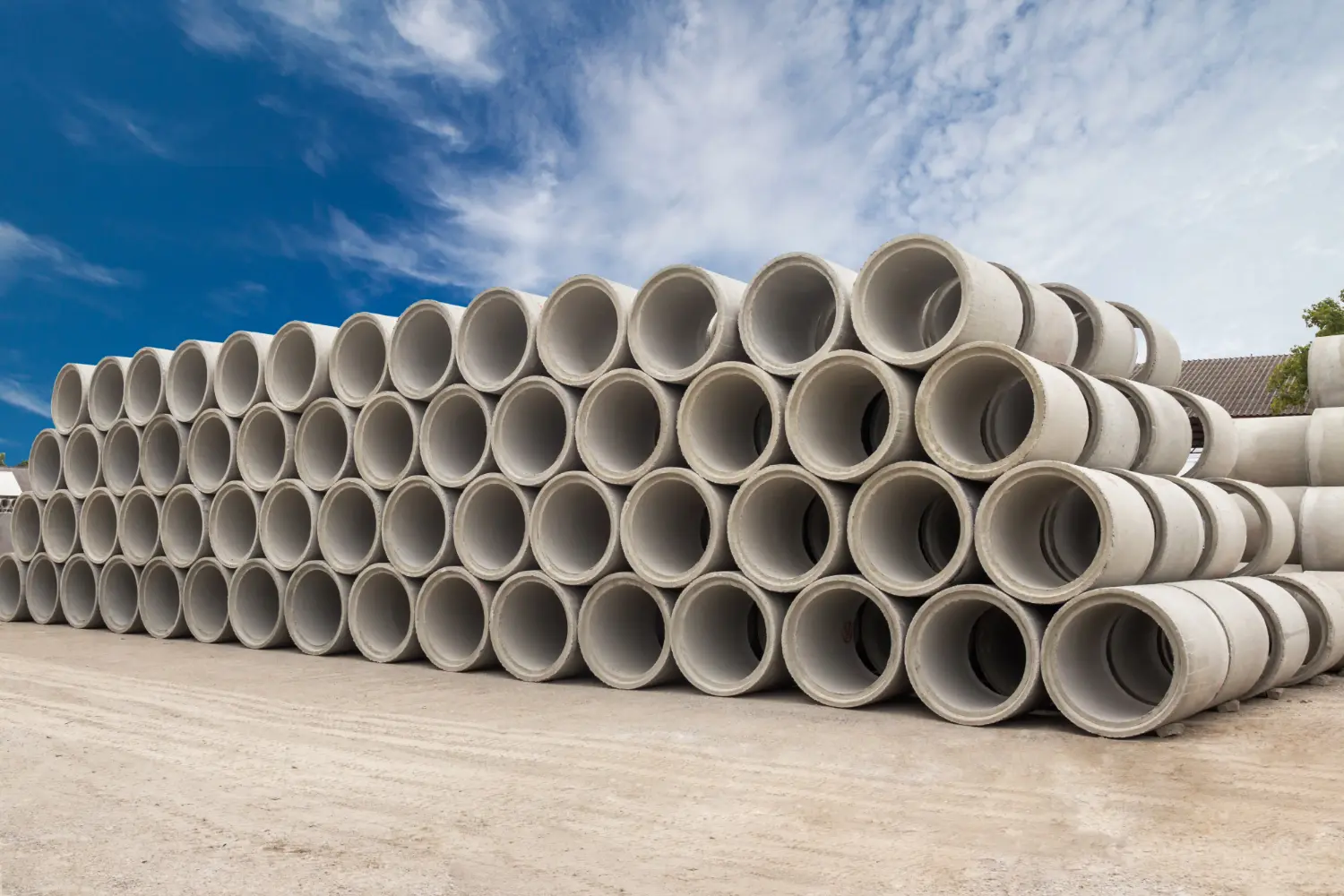
Reinforced cement concrete pipes, commonly known as RCC pipes or Hume pipes, are used in suitable drainage, water-conveyance and underground infrastructure applications.
Their selection depends on the intended flow, installation conditions, external loading and relevant design requirements.
RCC pipes may be considered for:
- Stormwater drainage networks.
- Roadside and cross-drainage systems.
- Underground water-conveyance applications where appropriate.
- Industrial and site drainage infrastructure.
- Selected utility and civil engineering works.
Pipe diameter, class, jointing arrangement, bedding, cover depth and installation conditions must be considered before procurement.
The required pipe specification should be established by the project's design rather than selected solely according to nominal diameter or price.
For projects evaluating concrete pipe solutions, Sachi Precast provides RCC pipes and Hume pipes.
2. Precast box culverts for road and drainage crossings
Box culverts provide an enclosed passage for water beneath roads, embankments and other crossings where the design requires this type of structure.
They are commonly evaluated for highway works, industrial access roads, infrastructure developments and drainage crossings.
Potential applications include:
- Cross-drainage beneath roads.
- Water passages within industrial developments.
- Drainage crossings at renewable energy sites.
- Infrastructure requiring a designed rectangular culvert opening.
The culvert must be selected according to the required hydraulic capacity, structural loads, soil conditions, cover depth and site geometry.
Engineers should also evaluate jointing, bedding, foundation preparation, backfilling and the effects of imposed traffic or equipment loads.
For commercial procurement, the quotation should specify the required internal dimensions, component configuration, design criteria and installation responsibilities.
Explore Sachi Precast's box culvert solutions for suitable infrastructure applications.
3. Precast U drains for surface water management
U drains are used in suitable drainage systems to collect and convey water along roads, site boundaries, paved areas and infrastructure corridors.
Depending on the design, they may be installed with covers to accommodate access requirements or the intended use of the surrounding area.
Typical applications include:
- Industrial campuses.
- Internal roads and service corridors.
- Renewable energy facilities.
- Commercial and infrastructure developments.
- Site drainage systems around buildings and paved surfaces.
Important selection factors include channel dimensions, gradient, design flow, cover loading, joint details, discharge points and maintenance access.
Where vehicles or heavy equipment may cross the drainage system, the cover and supporting arrangement must be designed for the relevant loads.
Precast drainage sections can be useful where repeated lengths are required, but the overall drainage layout must be designed to ensure adequate flow and connection to the wider system.
Sachi Precast offers U drains with covers for applicable drainage requirements.
4. Precast manhole chambers for underground networks
Manhole chambers provide access to suitable underground drainage and utility systems for inspection, maintenance and operational activities.
They can form part of stormwater networks, wastewater systems and other underground infrastructure where access chambers are specified.
Common applications include:
- Stormwater drainage networks.
- Underground drainage systems.
- Industrial utility infrastructure.
- Road and site development projects.
- Selected municipal and commercial developments.
The required chamber size depends on the network design, connected pipe sizes, access requirements, cover loading and installation depth.
Contractors should verify the location and elevation of connections, compatibility with the connected pipes, cover requirements and access provisions before placing an order.
Chambers must also be coordinated with other underground services to avoid conflicts with foundations, roads and utility routes.
Sachi Precast supplies precast manhole chambers for applicable infrastructure projects.
5. Junction chambers for connecting infrastructure systems
Junction chambers are used where a network requires a connection point between multiple routes or components.
Depending on the design, they may support drainage or other infrastructure systems that need a defined junction and access arrangement.
Their application requires coordination between the connecting elements, internal dimensions, entry and exit levels, and maintenance requirements.
For project teams, the important consideration is ensuring that the chamber matches the network layout rather than treating it as a standard enclosure independent of the connected system.
Sachi Precast offers junction chambers for suitable infrastructure requirements.
6. Precast retaining walls for earth retention
Retaining walls are used where soil must be retained to accommodate changes in ground elevation or create usable development platforms.
They may be required at industrial sites, infrastructure corridors, access roads and other developments where the ground profile makes earth retention necessary.
Precast retaining wall systems can be considered when the structural design, foundation conditions and installation method support their use.
The design should account for:
- Retained soil conditions.
- Surcharge loads.
- Groundwater and drainage behind the wall.
- Foundation stability.
- Overall wall geometry.
- Construction access and installation requirements.
Retaining walls are engineered structures. Their dimensions and configuration must be determined by the design conditions, not simply by the height of the visible wall.
Explore precast retaining wall solutions from Sachi Precast.
7. Precast foundations and footings with pedestals
Foundations transfer structural loads to the ground and must be designed according to the supported structure, soil conditions and loading requirements.
Precast foundations can be considered for selected infrastructure and industrial applications where factory-manufactured elements meet the project's design requirements.
Potential uses depend on the engineering design and may include suitable equipment foundations, structural supports and other infrastructure installations.
Before procurement, the project team should establish:
- Design loads and foundation geometry.
- Soil and bearing conditions.
- Reinforcement requirements.
- Connection and anchoring details.
- Lifting and handling provisions.
- Installation tolerances and support conditions.
Not all foundations are suitable for precast construction. The decision depends on structural design, ground conditions, component size and installation feasibility.
Sachi Precast offers footings with pedestals for suitable project applications.
8. Precast slope drains for managing runoff
Slope drains can be used in suitable infrastructure settings to guide surface runoff along designated paths, including sloping ground and selected embankment areas.
They may be relevant to road infrastructure, site development and renewable energy projects where runoff needs to be conveyed along a controlled route.
Their design should consider the expected water flow, slope geometry, outlet arrangements, erosion risk and connection to the drainage system.
The installation must also account for the site's ground conditions and the method used to secure and align the drainage sections.
Sachi Precast provides precast slope drains for applicable infrastructure requirements.
9. Precast slabs for structural applications
Precast concrete slabs can be considered for suitable structural and infrastructure applications where their dimensions, loading characteristics and support arrangements match the approved design.
Their use depends on the intended function, span, reinforcement, connection details, handling requirements and overall structural system.
Project teams should verify the required design loads, support conditions, tolerances and installation sequence before specifying a slab.
Sachi Precast offers solid precast slabs for suitable applications.
10. Precast tanks and other customised components
Certain infrastructure and industrial projects require concrete tanks or other components manufactured around specific operational requirements.
The design may depend on the contents, loading, exposure conditions, dimensions, waterproofing requirements and connection details.
Customised precast components may also be considered when a project needs a specific geometry or configuration that is not adequately addressed by a standard product.
Sachi Precast's wider product portfolio provides a starting point for discussing available components and project-specific requirements.
The final specification should be confirmed through technical review before manufacturing begins.
Which precast products are relevant to different Indian infrastructure sectors?
The product requirements of an infrastructure project depend on the function of the development, its engineering design and its site conditions.
The following overview illustrates how different precast products may be considered across sectors.
Roads and highway infrastructure
Road projects may require drainage crossings, roadside water management and underground infrastructure.
Products that may be considered include:
- RCC pipes for suitable drainage applications.
- Box culverts for designed water crossings.
- U drains for surface water conveyance.
- Manhole and junction chambers for access and network connections.
- Retaining walls where changes in ground elevation require earth retention.
The final selection must follow the project's hydraulic, structural and road-design requirements.
Renewable energy infrastructure
Solar and other renewable energy developments require supporting civil infrastructure in addition to the primary energy-generation equipment.
Depending on the project, this may include drainage systems, foundations, utility structures, tanks and other precast components.
Site conditions can be especially important for developments spread across large or remote areas. Transportation, installation access and production scheduling should be evaluated early.
Sachi Precast's documented work includes the Adani Green Renewable Park and NTPC Solar Park, providing examples of precast applications within renewable energy developments.
Industrial and manufacturing facilities
Industrial developments require supporting infrastructure designed around site operations, equipment, access and utility requirements.
Potential precast applications include foundations, drainage channels, culverts, chambers, retaining walls and other components specified in the civil works package.
The selection should account for heavy vehicle movements, site drainage, underground services, maintenance access and the facility's operational requirements.
Rail and transport infrastructure
Rail and transport projects may require numerous precast components, ranging from drainage and retaining elements to structural components designed for specific applications.
Such projects often involve coordination across multiple work locations and construction packages.
Sachi Precast's documented scope on the Mumbai–Ahmedabad Bullet Train project includes columns, footings, wall panels, retaining walls, U drains, box culverts, junction chambers, slope drains and pedestals.
This demonstrates how different precast product categories can contribute to a single large infrastructure programme.
Commercial and large-site development
Commercial campuses, warehouses and large developments may require drainage, utility access, retaining structures and supporting civil works.
Precast solutions can be evaluated for repetitive components where manufacturing, transport and installation conditions are suitable.
The final product mix depends on the site's layout, building design, drainage strategy and operational requirements.
What determines the cost of precast concrete products in India?
There is no single price that applies to every precast concrete product. Costs vary according to the product type, dimensions, technical specifications, manufacturing requirements and delivery conditions.
For procurement teams, understanding these variables is more useful than comparing unit prices without considering the complete scope.
Product dimensions and quantities
Larger or heavier components generally require different quantities of materials, production resources and handling arrangements.
Total order quantities can also influence production planning and the commercial terms offered by a manufacturer.
Concrete and reinforcement specifications
The required concrete properties, reinforcement details and design loads influence the manufacturing requirements.
A product designed for heavier loads or more demanding site conditions may require a different specification from a component intended for a lighter application.
Specifications should be based on the approved design rather than reduced simply to achieve a lower purchase price.
Moulds and customisation
Standardised products may be manufactured using existing moulds, while customised products can require additional design coordination, tooling or production setup.
The impact depends on the complexity of the component and whether the mould or configuration can be reused across multiple units.
Transportation and unloading
Transportation costs depend on the manufacturing location, delivery distance, component dimensions, vehicle requirements and route conditions.
Heavy or oversized components may require specialised transportation and additional planning.
Unloading equipment and site access arrangements should also be considered when evaluating the total delivered cost.
Installation and associated civil works
The complete installed cost may include excavation, foundations or bedding, lifting equipment, jointing, backfilling, connections and finishing work.
A product quotation that excludes these activities should not be compared directly with an alternative that includes them.
For a more detailed discussion of cost variables, see Precast Concrete Price in Gujarat: What Determines the Cost of Precast Products.
How to evaluate a precast concrete manufacturer for a commercial project
Choosing a manufacturer is not only a purchasing decision. It affects product compliance, delivery planning, installation coordination and the overall execution of the project.
A structured evaluation helps buyers compare suppliers against the same requirements.
Product capability and technical suitability
Confirm that the manufacturer can supply the required product category and meet the project's dimensions, loads, connections and other specifications.
For customised components, discuss the drawings, manufacturing feasibility, tolerances and inspection requirements before confirming the order.
Manufacturing capacity and delivery commitments
For large orders, ask how the supplier will schedule production and coordinate dispatches.
The proposed delivery plan should reflect the required quantities, production lead times, transportation arrangements and installation sequence.
Do not assume that a manufacturer can meet a specific volume or deadline without confirming it for the project.
Quality assurance and testing
Establish the inspection and testing requirements applicable to the product.
Depending on the contract and relevant standards, documentation may include concrete test results, dimensional checks, production records and component acceptance information.
The manufacturer's quality processes should align with the project's specifications and quality plan.
Transportation and installation responsibilities
Confirm whether the quotation covers manufacturing only or also includes delivery, unloading, erection and related work.
Clear allocation of responsibilities helps prevent gaps between the manufacturer, transport provider, EPC contractor and site team.
Relevant project experience
Review previous work that is relevant to the intended application, component type and project scale.
Project experience can demonstrate familiarity with practical execution requirements, but the proposed solution must still be verified against the new project's specifications.
For additional guidance, read How to Choose the Right Precast Concrete Manufacturer in India.
Why infrastructure buyers consider Sachi Precast
For a buyer sourcing precast concrete products, the important questions are whether the manufacturer can meet the required specifications, provide the relevant products and coordinate delivery according to the project scope.
Sachi Precast is based in Gujarat and offers a range of precast products for infrastructure, industrial and renewable energy applications.
A product range covering multiple infrastructure requirements
Sachi Precast's portfolio includes RCC pipes, box culverts, manhole chambers, junction chambers, U drains with covers, slope drains, retaining walls, footings, slabs, tanks and other precast components.
This range allows project teams to evaluate different product categories through the company's precast product portfolio.
The availability and suitability of specific products, dimensions and customised configurations should be confirmed during technical and commercial discussions.
Experience across major infrastructure applications
Sachi Precast documents work across rail infrastructure and renewable energy developments, including the Mumbai–Ahmedabad Bullet Train project, Adani Green Renewable Park, NTPC Solar Park and Tata Power Mundra.
These projects represent different infrastructure environments and demonstrate the company's involvement in projects requiring a range of precast components.
Explore the Sachi Precast project portfolio to learn more about its documented project experience.
Manufacturing and project-level execution
Depending on the project scope, precast procurement can involve manufacturing, supply and on-site installation.
Sachi Precast's documented project work includes manufacturing, supply and installation for selected projects. Buyers should confirm the exact deliverables, technical responsibilities, commercial terms and schedule for each new requirement.
For developers and EPC contractors, this clarification is important when comparing quotations and determining the overall scope of a precast package.
A project-specific approach to procurement
Infrastructure projects differ in dimensions, loading, site conditions and delivery requirements.
Rather than selecting products based on general descriptions alone, buyers should share the relevant drawings, quantities, specifications and delivery location so that the requirement can be evaluated appropriately.
To discuss a project requirement, visit Sachi Precast's contact page.
Frequently Asked Questions
What precast concrete products are commonly used in infrastructure projects in India?
Common product categories include RCC pipes, box culverts, U drains, manhole chambers, junction chambers, retaining walls, foundation elements, slabs and other components selected according to the project's design.
How do I choose the right precast concrete product for my project?
Start with the intended application, approved drawings, dimensions, loading requirements, site conditions and applicable standards. For drainage products, hydraulic capacity and connections are also important. Final selection should be confirmed with the project's design team.
Are precast concrete products suitable for large infrastructure projects?
They can be suitable for many infrastructure applications, including drainage, road crossings, foundations, retaining systems and selected structural works. Suitability depends on engineering requirements, manufacturing feasibility, transportation and installation conditions.
What information should I provide when requesting a precast quotation?
Provide the product type, approved drawings, dimensions, quantities, technical specifications, delivery location and required schedule. Also clarify whether the quotation should include transportation, unloading, installation and associated work.
What affects precast concrete product prices in India?
Major cost factors include product dimensions, concrete and reinforcement specifications, quantity, mould requirements, customisation, transportation, unloading and installation. The complete scope should be considered when comparing quotations.
Does Sachi Precast provide multiple types of precast infrastructure products?
Yes. Its published portfolio includes RCC pipes, box culverts, U drains with covers, manhole chambers, junction chambers, slope drains, retaining walls, foundations, slabs, tanks and other products. Specific configurations should be confirmed against project requirements.
Can precast products be customised for a project?
Project-specific configurations may be possible depending on the product, manufacturing feasibility and engineering requirements. Customisation should be reviewed against approved drawings, quality criteria, quantities and the project schedule before an order is finalised.
Conclusion
Precast concrete products support many of the systems that make infrastructure projects functional, from drainage and underground utilities to foundations, retaining structures and selected structural applications.
For Indian infrastructure buyers, selecting the right component requires more than identifying a product category. Dimensions, structural and hydraulic requirements, manufacturing quality, transportation, installation and total project cost must all be considered.
A well-defined procurement process helps developers and EPC contractors compare suppliers against the same technical and commercial requirements.
Sachi Precast offers a range of precast concrete products for infrastructure, industrial and renewable energy applications, supported by documented experience across major projects.
If you are planning a road, industrial facility, renewable energy development or other infrastructure project, begin by defining the required products, quantities, specifications and delivery schedule. These details provide the basis for evaluating the appropriate precast solution and confirming its suitability for your project.
Contact Sachi Precast to discuss your precast concrete requirements.
Build Smarter With Sachi Precast
From ready-made precast components to fully customized solutions, we handle everything from manufacturing to on-site erection — delivering faster, stronger, and more efficient construction outcomes.