
Precast vs Traditional Construction: Which Is Better for Your Project?
Choosing the right construction method is one of the most important decisions in any infrastructure or industrial project. The method you select directly affects your project timeline, overall cost, structural durability, and long-term performance.In India’s rapidly evolving construction sector, developers and contractors are increasingly comparing two major approaches: traditional on-site construction and precast concrete construction.Both methods use concrete. Both can deliver strong structures. But the way they are executed — and the results they produce — can be very different.If you are planning a commercial, industrial, infrastructure, or large-scale development project, understanding this difference is critical.
What Is Traditional Construction?
Traditional construction, also known as cast-in-situ construction, involves mixing and pouring concrete directly at the project site. The entire process — formwork setup, reinforcement placement, concrete pouring, curing, and finishing — happens on location.
This method has been used for decades and is still common in residential and small-scale projects.
However, traditional construction is highly dependent on:
- Weather conditions
- Skilled on-site labor
- Time-consuming curing processes
- Manual supervision and quality control
While it offers flexibility in design changes during execution, it also increases uncertainty in timelines and quality consistency.
What Is Precast Concrete Construction?
Precast construction follows a different approach.
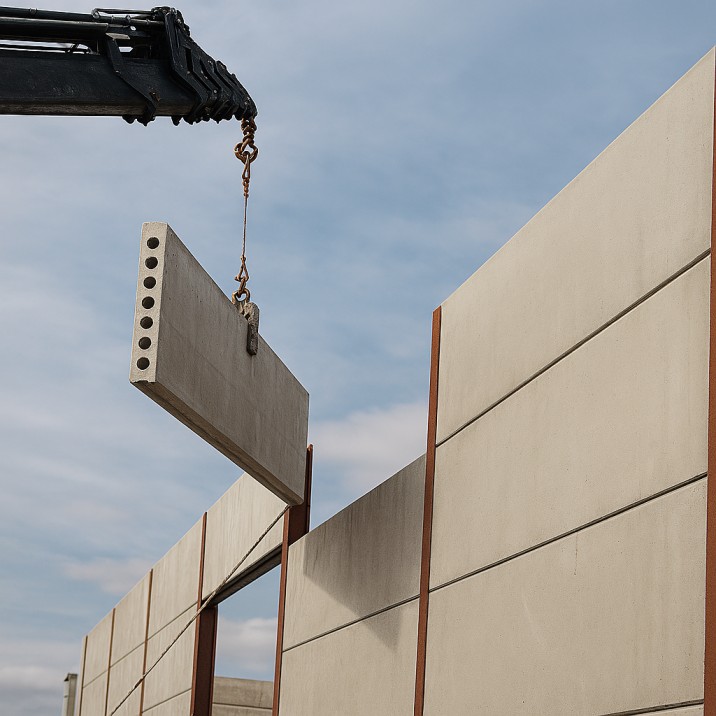
Instead of casting concrete at the site, structural components are manufactured in a controlled factory environment. These components — such as walls, beams, columns, slabs, box culverts, retaining walls, manholes, and other infrastructure elements — are produced with precision and then transported to the construction site for installation.
Because production and site preparation can happen simultaneously, precast construction significantly reduces overall project duration.
Precast solutions are increasingly being adopted in highways, metro systems, solar plants, railway projects, industrial complexes, and government infrastructure developments across India.
Speed of Execution: A Major Deciding Factor
In modern construction, time equals money.
Traditional construction requires sequential execution. First, formwork is prepared. Then reinforcement is placed. Concrete is poured. After that, curing must take place before moving to the next stage. Any delay — due to rain, labor shortage, or supply issues — can slow down the entire project.
Precast construction changes this dynamic completely.
While site work is ongoing, structural components are simultaneously manufactured in the factory. Once ready, they are transported and installed quickly. This parallel workflow drastically reduces construction time.
For infrastructure projects with strict deadlines — such as highway expansions, railway corridors, renewable energy parks, or industrial plants — precast construction provides a strong advantage in meeting timelines efficiently.
Quality Control and Structural Consistency
Quality in traditional construction largely depends on on-site management. Variations in temperature, humidity, and labor skill levels can impact curing quality and finishing standards.
Even small inconsistencies can affect structural durability over time.
Precast concrete components are manufactured under strict quality-controlled conditions. Advanced machinery, standardized molds, and controlled curing environments ensure:
- Uniform strength and density
- High precision and dimensional accuracy
- Reduced structural variation
- Improved surface finish
For large infrastructure projects where structural reliability is non-negotiable, precast construction offers superior consistency and long-term durability.
Cost Efficiency: Looking Beyond Initial Estimates
At first glance, traditional construction may appear more economical because it avoids transportation and factory manufacturing costs.
However, real project cost involves more than material expenses.
Traditional construction often leads to:
- Higher labor costs
- Material wastage
- Delays due to weather
- Increased supervision requirements
- Rework due to quality inconsistencies
Over time, these factors increase overall project expenditure.
Precast construction reduces on-site labor dependency and material wastage. Faster completion also lowers indirect costs such as equipment rental, site management, and financing expenses.
When viewed from a total lifecycle cost perspective, precast solutions often prove more economical for medium and large-scale projects.
Weather Dependency and Project Risk
India’s climate can be unpredictable, especially during monsoon seasons. Traditional construction is highly sensitive to weather conditions. Heavy rain can delay concrete pouring, affect curing quality, and extend project schedules.
Precast components, however, are manufactured in controlled indoor environments. Weather has minimal impact on production quality. Site installation is also faster, reducing exposure to climate-related risks.
For time-bound projects, minimizing environmental uncertainty is a significant advantage.
Safety and Site Management
Construction sites with large labor forces, heavy machinery, and continuous concrete mixing operations increase safety risks.
Traditional construction requires more manpower and prolonged on-site activity.
Precast construction reduces on-site operations significantly. Since major structural components arrive ready for installation, site congestion decreases. Fewer laborers and shorter working durations improve safety standards and simplify site management.
For industrial and government projects where compliance and safety audits are strict, this becomes an important factor.
Environmental Impact and Sustainability
Sustainable construction practices are gaining importance across India.
Traditional construction often leads to:
- Excess material wastage
- Higher water usage
- Increased on-site pollution
- Greater carbon footprint due to extended timelines
Precast manufacturing optimizes material usage through precise batching and reusable molds. Factory-controlled processes reduce waste and energy consumption.
Additionally, faster project completion lowers overall environmental impact.
For companies focused on sustainable development and green infrastructure, precast construction aligns better with long-term environmental goals.
Design Flexibility and Customization
One area where traditional construction offers flexibility is on-site design modifications. Adjustments can be made during execution, although this may increase cost and delay timelines.
Modern precast systems, however, are highly customizable. Advanced design planning and modular engineering allow for tailored solutions without compromising speed or structural integrity.
With proper planning and technical expertise, precast systems can meet complex infrastructure requirements efficiently.
Long-Term Durability and Maintenance
Durability is a crucial factor in infrastructure projects such as highways, bridges, solar parks, and industrial units.
Because precast components are produced under controlled curing conditions, they typically achieve higher strength consistency. This enhances long-term durability and reduces maintenance requirements.
Traditional construction can also achieve durability, but it heavily depends on execution quality and site conditions.
When structural performance over decades is considered, precast systems often provide more predictable results.
Which Construction Method Is Better for Your Project?
The answer depends on the nature and scale of your project.
Traditional construction may still be suitable for:
- Small residential buildings
- Projects requiring frequent design changes
- Limited-scale developments
Precast construction is generally more suitable for:
- Large infrastructure projects
- Industrial developments
- Time-sensitive projects
- Government contracts
- Highway and railway works
- Solar and renewable energy installations
If your priority is speed, quality consistency, cost efficiency over time, and structural reliability, precast construction provides a strong competitive advantage.
The Growing Shift Toward Precast in India
India’s infrastructure sector is evolving rapidly. With increasing focus on faster project delivery, standardized quality, and sustainable practices, precast construction is becoming a preferred choice among leading developers and contractors.
Major infrastructure initiatives, transportation corridors, and industrial projects are increasingly integrating precast solutions to meet modern demands.
This shift is not just a trend — it reflects the need for efficiency, precision, and scalability in construction.
Final Thoughts
Choosing between precast and traditional construction is not just about technique — it is about long-term strategy.
Traditional methods offer familiarity and flexibility.
Precast construction offers speed, precision, and scalability.
For modern infrastructure and industrial projects in India, precast concrete solutions are proving to be more aligned with current market demands.
If your project requires faster completion, consistent quality, improved safety, and long-term durability, precast construction may be the smarter investment.
Build Smarter With Sachi Precast
From ready-made precast components to fully customized solutions, we handle everything from manufacturing to on-site erection — delivering faster, stronger, and more efficient construction outcomes.